Buying guide
How to choose a watch
A good watch fits your wrist, your day and your budget. This guide walks through the choices in the order that matters most, so you can compare pieces with confidence.
In short
- 1Decide how the watch will be worn most days: office, sport, travel or evenings.
- 2Pick a movement: quartz for accuracy and low upkeep, mechanical for craft, smart for data.
- 3Measure your wrist and choose a case diameter from the size table below.
- 4Match water resistance to your activities, not to the deepest number available.
- 5Choose the strap last — it changes the character of the watch the most.
01
Movement
The movement is the engine of the watch. It decides accuracy, maintenance and how the seconds hand moves.
- Quartz
- Battery-powered and very accurate, typically within a few seconds per month. The battery lasts two to five years; little other maintenance is needed.
- Automatic
- A mechanical movement wound by a rotor as you move your wrist. Sweeping seconds hand, no battery. Service every five to eight years.
- Manual wind
- Mechanical and wound by the crown, usually every day or two. Thinner cases are possible because there is no rotor.
- Smart
- A small computer on the wrist: notifications, health sensors, GPS and payments. Needs charging every one to ten days depending on the model.
02
Case size
Diameter is measured across the case without the crown. Lug-to-lug — the distance between the strap ends — matters just as much: it should not extend beyond the top of your wrist.
Recommended case diameter
38–41 mm
Keep lug-to-lug under 53 mm
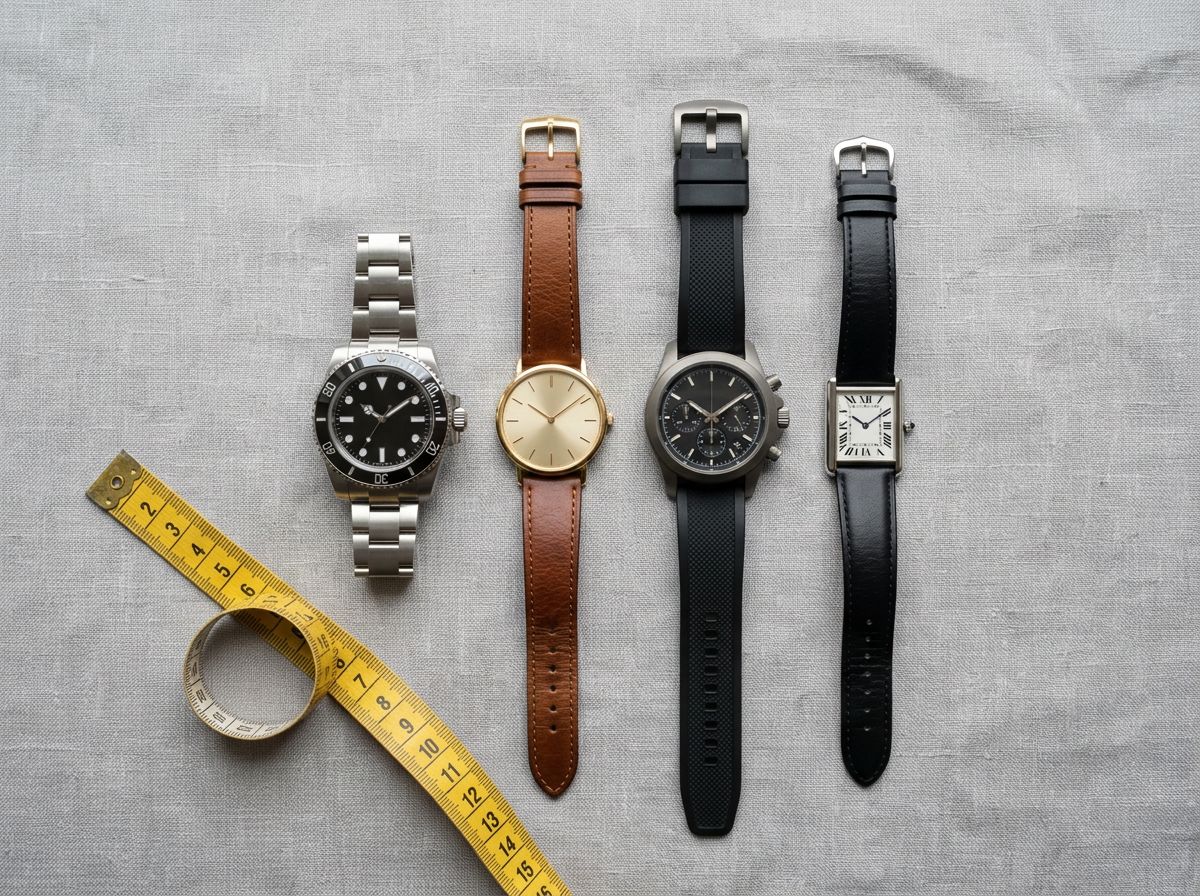
Wrap a strip of paper around your wrist just below the wrist bone, mark where it overlaps and measure it with a ruler.
| Wrist | Case diameter |
|---|---|
| 13–15 cm | 34–36 mm |
| 15–16.5 cm | 36–38 mm |
| 16.5–18 cm | 38–41 mm |
| 18–19.5 cm | 40–43 mm |
| 19.5–22 cm | 42–46 mm |
03
Case shape
Shape sets the tone of the watch before anything else is noticed.
- Round
- The most versatile shape and the easiest to seal against water. Suits every style.
- Rectangular
- Classic and slim, it slides under a shirt cuff and reads as formal.
- Square and cushion
- A strong, architectural look. Wears larger than the same round diameter.
- Tonneau
- Barrel-shaped and curved to follow the wrist; often found on sportier luxury pieces.
04
Case materials
The case material affects weight, scratch resistance and how the watch ages.
- Stainless steel 316L
- The standard for good reason: durable, corrosion-resistant and easy to polish.
- Titanium
- Around 40% lighter than steel and hypoallergenic. Slightly darker grey tone.
- Ceramic
- Very hard and scratch-resistant, keeps its colour. Can chip if dropped on stone.
- Gold
- Solid 18k gold is heavy and precious; gold-tone PVD or plating gives the look over steel.
- Bronze
- Develops a unique patina over time. Popular on dive and field watches.
05
Crystal
The crystal protects the dial. Look for an anti-reflective coating on any type for better legibility.
- Acrylic (Hesalite)
- Warm, vintage look and does not shatter. Scratches easily but can be polished.
- Mineral
- Hardened glass with good everyday resistance at a moderate price.
- Sapphire
- Synthetic sapphire is second only to diamond in hardness and is practically scratch-proof in normal wear.
06
Water resistance
The rating shows the pressure used in testing, not a safe diving depth. Use this table to translate it into real life.
| Rating | Suitable for |
|---|---|
| 3 ATM · 30 m | Rain and splashes, washing hands. Not for swimming. |
| 5 ATM · 50 m | Short, shallow swims. Avoid hot showers and saunas. |
| 10 ATM · 100 m | Swimming and snorkelling. |
| 20 ATM · 200 m | Water sports and recreational snorkelling at depth. |
| ISO 6425 diver | Scuba diving. Each piece is tested to the diving standard. |
Never operate the crown or chronograph pushers under water, and have seals checked during every service.
07
Strap and bracelet
Most watches accept other straps of the same lug width, so you can change the look in minutes.
- Steel bracelet
- Durable and water-friendly. Links can be removed for a precise fit.
- Leather
- Classic and comfortable. Keep it away from water and replace it every year or two of daily wear.
- Rubber and silicone
- Made for sport and water, easy to clean.
- Textile and NATO
- Light, breathable and inexpensive. A quick way to make a watch casual.
- Mesh
- Fine steel weave, adjustable to any size, with a distinctive retro look.
08
Complications
Anything beyond hours, minutes and seconds is a complication. Choose the ones you will actually use.
- Date
- The most useful addition. Some models also show the day of the week.
- Chronograph
- A stopwatch operated by pushers beside the crown.
- GMT and dual time
- Shows a second time zone — ideal for frequent travellers.
- Moon phase
- A decorative display of the lunar cycle, typical of dress watches.
- Power reserve
- Indicates how long a mechanical watch will run before it needs winding.
09
Style and occasion
If you own one watch, choose the most versatile style. A second watch can be more specialised.
- Dress
- Thin case, simple dial, leather strap. For suits and evenings.
- Everyday
- Steel case and bracelet, 100 m water resistance, clean dial. Works almost anywhere.
- Sport and dive
- Rotating bezel, luminous hands, robust build. Made for activity and water.
- Pilot and field
- Large, highly legible numerals on a matte dial. Rugged and casual.
Still deciding?
Send us your wrist size, budget and how you plan to wear the watch, and we will reply with a few suitable options.